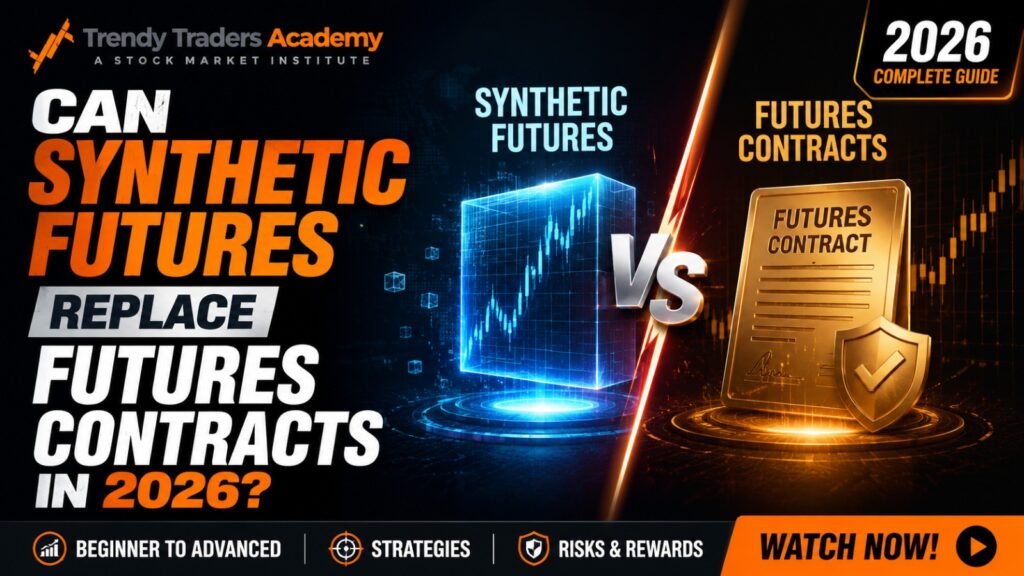
Can Synthetic Futures Replace Futures Contracts in 2026? Complete Beginner-to-Advanced Guide
The financial markets are changing at a rapid pace. As advanced option trading options become more accessible and the trading platforms start to provide more sophisticated derivatives options, many traders are asking one important question.
Will synthetic futures be the replacement of traditional futures in 2026?
If you’ve ever traded derivatives, you realise that the veteran traders typically construct trades using options rather than Future contracts. It’s a simple trick, but a business tactic called synthetic futures.
As options trading becomes more popular, liquidity is improving and there are better ways to manage risk, synthetic options are now becoming more attractive to retail and professional traders.
But does it mean that traditional futures contracts are becoming redundant?
The answer is No, but in certain market conditions synthetic futures have proved to be an extremely powerful alternative.
This guide will teach you all the basics up to advanced trading applications.
Quick Answer
Option combinations that mimic the payoff of a traditional futures contract are synthetic futures. Though the flexibility, limited capital requirements, and customization of risk that they offer might be more appealing than futures contracts, they cannot entirely replace futures due to liquidity, margin efficiency, execution simplicity, and institutional usage.

What Are Synthetic Futures?
A synthetic futures position is created by combining options to replicate the payoff of a futures contract.
Instead of buying one futures contract, traders combine:
- Buy Call Option
- Sell Put Option
Both options have:
- Same strike price
- Same expiry date
- Same underlying asset
The combined payoff behaves almost identically to holding the actual futures contract.
Think of it as building your own future position using options.
This concept is based on put-call parity, one of the most fundamental principles in derivatives pricing.
Why Are Trading Academies Becoming Popular?
A synthetic futures position is created by combining options to replicate the payoff of a futures contract.
Instead of buying one futures contract, traders combine:
Buy Call Option
Sell Put Option
Both options have:
Same strike price
Same expiry date
Same underlying asset
The combined payoff behaves almost identically to holding the actual futures contract.
Think of it as building your own future position using options.
This concept is based on put-call parity, one of the most fundamental principles in derivatives pricing.
Definition Box
Synthetic futures are an options strategy where traders combine long call and short put positions at the same strike price and expiry to replicate a futures contract without directly buying futures.
What Is a Futures Contract?
Before understanding synthetic positions, it’s important to know what is a futures contract.
A futures contract is an agreement between two parties to buy or sell an asset at a set price at a later date, and can be standardized in any number of different ways.
These contracts trade on exchanges like:
- NSE
- BSE
- CME Group
Common underlying assets include:
- Nifty 50
- Bank Nifty
- Gold
- Crude Oil
- Stocks
- Commodities
- Currencies
Unlike options buyers, futures traders have an obligation to settle the contract.
Futures Contract Example
Suppose Nifty is trading at 25,000.
You believe the market will rise.
You buy one Nifty futures contract at 25,000.
Scenario 1
Nifty reaches 25,500
Profit = 500 points
Scenario 2
Nifty falls to 24,600
Loss = 400 points
The payoff is linear.
How Does a Synthetic Futures Contract Work?
Let’s assume:
Current Stock Price = ₹1,000
You:
Buy 1000 Strike Call
Sell 1000 Strike Put
Same expiry.
Now observe.
Stock Price | Long Call | Short Put | Combined Position |
900 | 0 | -100 | -100 |
1000 | 0 | 0 | 0 |
1100 | +100 | 0 | +100 |
Notice something?
The payoff looks exactly like holding a futures contract.
That’s why professionals call this a synthetic futures contract.
Synthetic Long Futures
A synthetic long futures strategy is used when traders expect prices to rise.
Construction:
✅ Buy ATM Call
✅ Sell ATM Put
Same expiry
Same strike
Payoff Characteristics
Unlimited Profit
Unlimited Loss
Exactly like buying futures.
Suitable for:
Bullish traders
Swing traders
Positional traders
Synthetic Short Futures
A synthetic short futures strategy replicates selling futures.
Construction:
- Buy Put
- Sell Call
Same strike.
Same expiry.
Perfect for bearish market expectations.
Synthetic Futures vs Traditional Futures
Feature | Synthetic Futures | Futures Contract |
Built Using | Options | Futures |
Flexibility | High | Low |
Margin | Variable | Exchange Defined |
Liquidity | Depends on Options | Usually Better |
Execution | Two Trades | Single Trade |
Adjustment | Easy | Limited |
Strategy Customization | Excellent | Limited |
Hedging | Excellent | Excellent |
Why Professional Traders Use Synthetic Trading Strategy
Professional traders don’t always choose futures.
They choose the instrument that offers the best combination of:
Capital efficiency
Risk control
Flexibility
Liquidity
Sometimes that’s futures.
Sometimes it’s synthetic positions.
Advantages of Synthetic Futures
1. Greater Flexibility
Options allow traders to modify positions easily.
You can:
Roll strikes
Hedge
Convert into spreads
Reduce exposure
Traditional futures cannot offer this flexibility.
2. Better Risk Management
Synthetic positions allow traders to combine additional options for protection.
Example:
Synthetic Long
Protective Put
Now downside risk becomes limited.
3. Multiple Adjustment Opportunities
Market changed?
No problem.
You can:
Shift strikes
Change expiry
Hedge Delta
Reduce Gamma exposure
Professional option traders do this regularly.
4. Potential Margin Benefits
Depending on exchange rules and broker policies, some synthetic combinations may receive favorable margin treatment compared to naked options. However, traders should always verify current margin requirements before entering any position.
5. Better Hedging Tool
Institutional traders often use synthetic positions to hedge:
Equity portfolios
Index exposure
Commodity positions
Disadvantages of Synthetic Futures
Despite their advantages, synthetic futures have limitations.
Execution Risk
You must execute two option trades.
Price slippage can occur.
Liquidity Issues
Some option strikes have poor liquidity.
Wide bid-ask spreads increase costs.
Time Decay
Although synthetic futures replicate futures at expiry, option premiums are still influenced by factors such as implied volatility and time value before expiry.
Volatility Impact
Changes in implied volatility can temporarily affect the pricing of synthetic positions even if the underlying asset remains unchanged.
Practical Trading Example
Imagine Bank Nifty trades at 58,000.
Instead of buying futures, you create:
Buy 58,000 Call
Sell 58,000 Put
Expiry:
Monthly
After three weeks:
Bank Nifty reaches 59,200
Both positions combine to generate a payoff very close to holding Bank Nifty futures, after accounting for premiums, transaction costs, and any pricing differences.
Trading Psychology Matters More Than Strategy
One lesson experienced traders learn is that no strategy succeeds without discipline.
Many beginners believe synthetic positions are “safer” simply because they involve options. That misconception often leads to overconfidence and excessive leverage.
Successful traders:
- Follow predefined risk limits.
- Accept losses quickly.
- Avoid revenge trading.
- Size positions according to capital.
- Stay patient during volatile markets.
A profitable strategy can still lose money when emotions override discipline.
Risk Management Tips
Never risk more than 1–2% of your trading capital on a single trade.
Use stop-loss levels based on your trading plan.
Understand option Greeks especially Delta and Theta before trading synthetic positions.
Avoid illiquid strike prices with wide bid-ask spreads.
Always account for brokerage charges, taxes, and slippage when comparing synthetic futures with standard futures contracts.
Can Synthetic Futures Replace Futures Contracts in 2026?
The answer depends on the trader.
Synthetic futures are ideal for:
Traders comfortable with options.
Investors seeking flexible hedging strategies.
Market participants who actively manage positions.
Advanced derivatives traders.
Traditional futures remain better for:
High-liquidity execution.
Simple directional trading.
Institutional and algorithmic strategies.
Traders who prefer straightforward margin structures.
For most retail traders, synthetic futures are a valuable addition not a complete replacement for traditional futures.
Expert Insight
Traders who have had experience with the derivatives market may see synthetic futures as an additional instrument and not as the better choice. The optimal one depends on the circumstances of the market, the volatility, the liquidity and trading goals of the trader.
Forex experts benefit from having expertise in both futures and choices, because they can adjust to the market in place of depending on just one particular instrument.
Trendy Traders Academy is one of the Best Stock Market Institute in India, providing structured learning in derivatives, incorporating live and online courses in technical analysis, futures and options, and application to the market. Tens of thousands of pupils have been trained in the academy through structured courses and mentorship.
By learning from experienced mentors like Abhishek Jha, who has more than 15 years of trading experience and has trained over 45,000 learners by providing practical education in the market, aspiring traders can reduce their learning curve.
Conclusion
Synthetic futures have emerged as one of the most flexible instruments used in today’s derivatives business. Options offer a variety of ways to trade a futures contract and allow traders to closely mimic the payoff of an equity futures position, with added flexibility when it comes to hedging and managing trading positions.
They are not, however, a substitute for the regular futures contracts in every instance. Still, traditional futures have some benefits in terms of liquidity, ease of execution and institutionalization. The decision on the better choice is based on the trading targets, market conditions, and derivatives understanding of the trader.
Before selecting one instrument over another, a futures and options trader’s most important tasks for the beginner are to learn about the basics of futures and options trading, how synthetic futures strategies function, and disciplined risk management. Futures contracts and synthetic futures can be used as effective tools to develop a systematic trading strategy if the knowledge and trading plan are there.
FAQs
What are synthetic futures?
Synthetic futures are option combinations designed to replicate the payoff of a traditional futures contract.
What is a synthetic long futures strategy?
It involves buying an at-the-money call option and selling an at-the-money put option with the same strike price and expiry.
What is a synthetic short futures strategy?
A synthetic short futures position is created by buying a put option and selling a call option at the same strike and expiry.
Are synthetic futures better than futures contracts?
Not necessarily. Synthetic futures offer flexibility, while traditional futures generally provide simpler execution and better liquidity.
Do synthetic futures require margin?
Yes. Margin requirements depend on the exchange, broker, and the option positions involved.
Are synthetic futures suitable for beginners?
Beginners should first understand futures, options, and option Greeks before using synthetic strategies with real capital.
What are the main risks?
Execution risk, liquidity, transaction costs, implied volatility changes, and poor risk management.
Can synthetic futures be used for hedging?
Yes. They are commonly used to hedge stock portfolios, index exposure, and other derivative positions.
What is the difference between synthetic futures and equity futures?
Synthetic futures are built using options, while equity futures are standardized exchange-traded futures contracts on individual stocks.
Can synthetic futures replace futures contracts completely?
No. They are a powerful alternative in many situations but cannot entirely replace traditional futures because of differences in liquidity, simplicity, and institutional usage.