
Top 5 Best Oil and Gas Stocks in India to Watch 2026
The world energy market is currently passing through a period of high volatility. The international crude oil prices have not been stable as of March 2026 with the Brent crude presently oscillating within the 100-116 per barrel. A significant part of this upward trend can be attributed to the increasing geopolitical tensions in the Middle East, as well as the constant threats to the main shipping routes including the Strait of Hormuz.
This poses a macroeconomic challenge to India. The nation is an importer of nearly 85% of the total oil and gas stocks in India needs and due to this fact, even a moderation of 10 dollars increase in the international prices is known to increase national import bill by approximately 12 to 15 billion dollars.
This can be termed as an imported inflation which is putting strain on the Indian Rupee and on the other hand constraining the capacity of the Reserve Bank of India (RBI) to make monetary changes.
In equity markets, the effect is not very even. The increased crude price tends to favor the upstream exploration companies such as ONGC because realizations per barrel will increase directly. Conversely, the Oil Marketing Companies (OMC) like IOCL, BPCL and HPCL are likely to experience marginal pressure.
It is not always possible to transfer increased crude prices to end consumers because of domestic prices. These structural differences of oil and gas sector stocks must be realised in the process of analysing the market cycle or evaluating the sector on a fundamental basis.
Overview of the the oil and gas stocks sector
Practically, a starting point to investors in the initial stages of learning the oil and gas sector stocks space will be to monitor sectoral indices. Instead of going directly into the individual companies, following such indices gives a more general view of the health of the sector, the valuation levels, and the direction.
Two indices are specifically applicable in the Indian equity market and these include the Nifty Energy index and the Nifty Oil and Gas stocks index.
The Nifty Energy index is more of a macro view. It encompasses corporations that engage in the generation, transmission and traditional oil business besides diversified conglomerates and utility services.
The Nifty Oil and gas index by comparison, is more concentrated. It monitors the companies that are directly involved in exploration, refining, and distribution of gas, hence providing a better picture of the pure-play petroleum segment.

Top 5 best Oil and Gas Stocks in India
- Reliance Industries Limited (RIL)
- Oil and Natural Gas Corporation (ONGC)
- Indian Oil Corporation Limited (IOCL)
- Bharat Petroleum Corporation Limited (BPCL)
- Hindustan Petroleum Corporation Limited (HPCL)
Detailed Fundamental Overview: The Big Five oil and gas stocks in India
Before deciding on investments, one should examine which companies within the sector maintain the best overall performance. The best oil and gas stock companies in India include the following group of leaders:
1. Reliance Industries Limited (RIL)
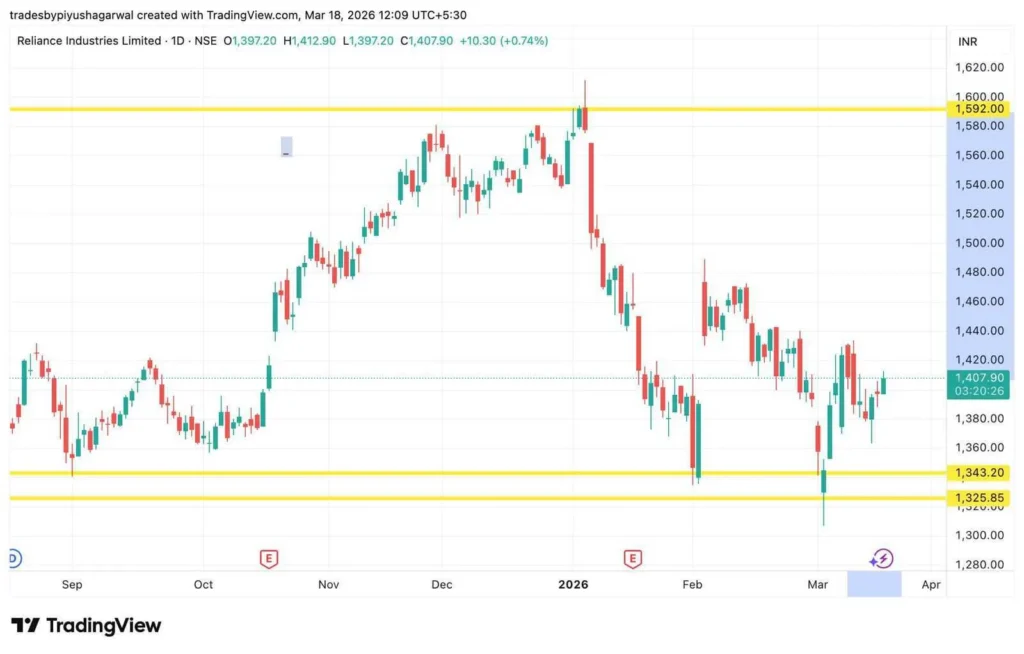
- Reliance Industries has evolved into a diversified conglomerate over time, though its Oil to Chemicals (O2C) segment continues to contribute significantly to revenues.
- The company operates the world’s largest single-location refinery at Jamnagar. This scale provides a notable “complexity” advantage, enabling Reliance to process heavier and relatively cheaper crude grades that many standard refineries cannot handle.
- Even as the company pushes aggressively into the “New Energy” space, its refining margins remain central to its valuation framework.
2. Oil and Natural Gas Corporation (ONGC)
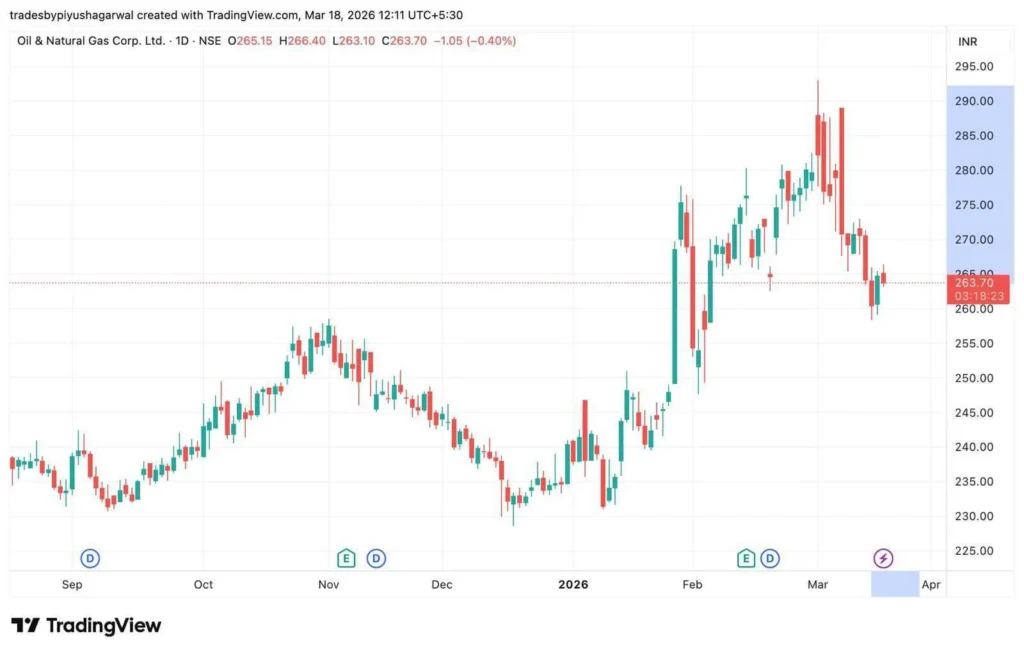
- ONGC stands as India’s leading pure-play upstream company. It accounts for approximately 70% of the country’s domestic crude production.
- In periods of rising global crude prices, ONGC is typically among the first beneficiaries. Higher prices translate directly into improved realizations per barrel.
- At a P/E multiple of around 8.7x, the stock continues to attract value-oriented investors, particularly in high oil price environments.
3. Indian Oil Corporation Limited (IOCL)
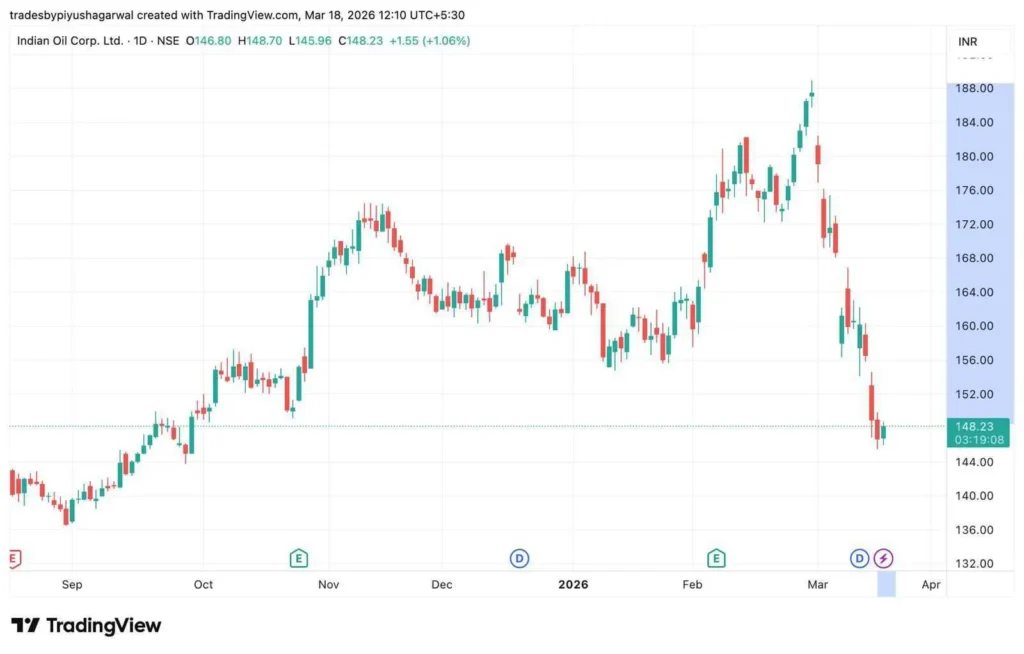
- IOCL is the largest commercial enterprise in India and commands nearly half of the domestic retail fuel market.
- The Moat: It has the strength in the vast distribution network of more than 34,000 fuel stations with a comprehensive network of pipelines.
- Risk Profile: The company has a significant amount of debt, which is mainly attributed to the current capital expenditure.
- Being a downstream player, its profitability directly correlates with the marketing margins, which is the difference between the cost of acquiring crude and the prices that they sell to the customer.
4. Bharat Petroleum Corporation Limited (BPCL)
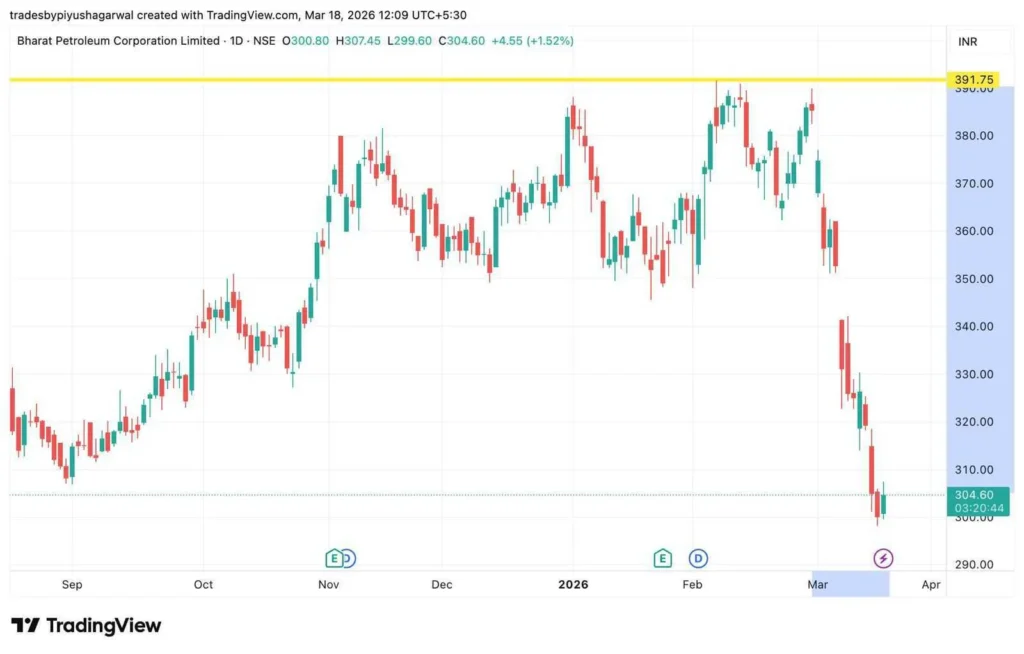
- BPCL is commonly considered operationally efficient out of the state-run OMCs. It has a good market in the urban market, especially the high-end retail stores.
- BPCL and Iocl compare quite similarly with Bpcl having a relatively lean structure and being perceived to be efficient therefore they trade slightly higher in relation to P/E ratio.
5. Hindustan Petroleum Corporation Limited (HPCL)
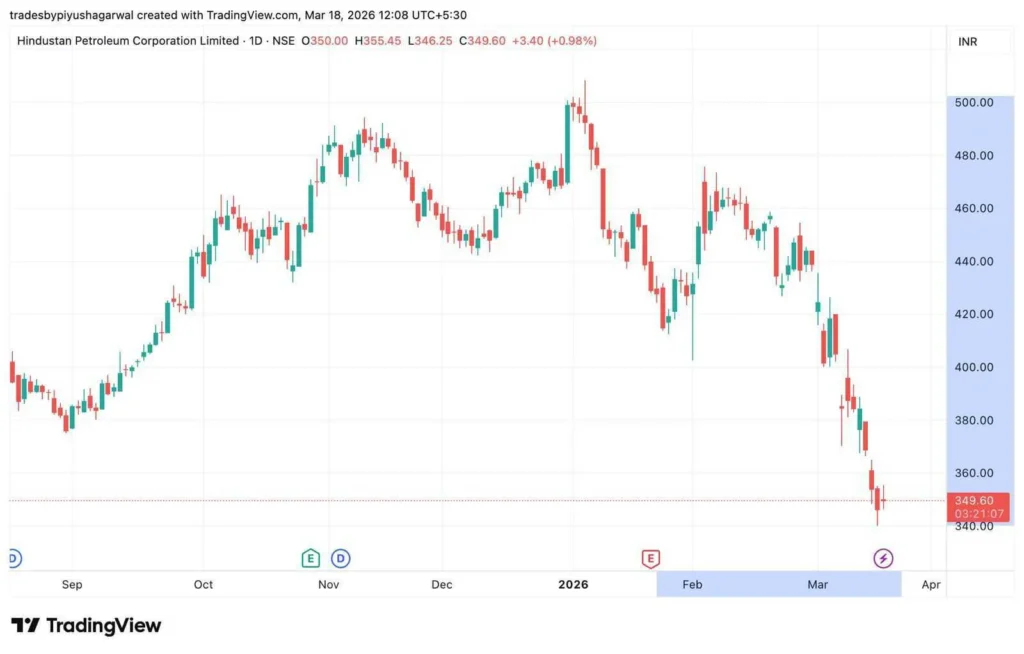
- HPCL functions largely as a marketing-driven OMC. The company benefits from strong brand recall and an extensive LPG distribution network.
- HPCL’s refining capacity is lower relative to its marketing volumes. This leads to a dependence on external procurement of refined products, making it more vulnerable during sharp increases in crude prices.
- With the exception of Reliance, all these companies are Public Sector Undertakings (PSUs). Alongside capital appreciation, they have historically offered relatively attractive dividend yields.
Fundamental Comparison Table of oil and gas sector stocks
Stock Name | M-Cap (₹ Cr) | P/E Ratio | Dividend Yield | Debt/Equity | ROE (%) |
Reliance | 19,50,000+ | 22.5 | 0.3% | 0.38 | 9.5% |
ONGC | 3,45,000+ | 8.7 | 4.5% | 0.55 | 14.2% |
IOCL | 2,10,000+ | 6.1 | 4.8% | 1.05 | 18.5% |
BPCL | 1,35,000+ | 5.6 | 5.2% | 0.85 | 16.1% |
HPCL | 65,000+ | 5.1 | 3.9% | 1.20 | 12.8% |
Why the Cartel Matters for Your Portfolio
Within Indian equities, these five companies collectively exert a level of influence that resembles a regulated cartel. Their presence spans the entire energy value chain—from upstream exploration to downstream retail distribution.
As a result, investing in these stocks is not merely a bet on individual businesses. It is, more broadly, a position on India’s long-term energy consumption trajectory.
- Crude at $70–$80: This range typically creates a favorable environment for OMCs (IOCL, BPCL, HPCL), allowing for relatively stable and healthy marketing margins.
- Crude at $100+: Capital tends to shift toward upstream players (ONGC, Reliance), as higher prices improve per-barrel realizations.
- The “Russian” Discount: A key variable to monitor is the discount on Russian Urals crude. Access to discounted imports has played a significant role in supporting OMC profitability in recent quarters.
Conventional market wisdom suggests that opportunities often arise when sentiment is weak. Despite their stable business models, all five companies are currently trading below their all-time highs (ATH) indicating a potential valuation gap:
- ONGC: Down 11.54% from ATH
- RELIANCE: Down 13% from ATH
- IOCL: Down 22% from ATH
- BPCL: Down 23.12% from ATH
- HPCL: Down 33% from ATH
Conclusion
The oil and gas stocks in India industry has remained a major activity of the Indian economy. Although a gradual transition period to renewable energy is being reached, the traditional oil and gas sector stocks will probably continue to be the major sources of liquidity in the markets within the next decade.
The sector has opportunities depending on various investment goals whether the investor is attracted by the size of Reliance, or by the relatively steady dividend rates of IOCL and BPCL.
These cycles, however, need a systematic way of understanding and navigating these cycles. The Market Udaan course at Trendy Traders Academy has been made so that people can get to know the basics of the course and then grow up to the advanced trading methods without the expense factor.
Also Read : Best Trading Books for Beginners
Disclaimer
The blog is strictly educational and is not financial advice. Stock investment is associated with risk. Before you make any investments, it is always a good practice to seek the advice of a financial advisor that is registered by SEBI.
FAQ'S
What are oil and gas stocks?
Oil and gas stocks are shares of companies involved in the exploration, extraction, refining, transportation, or distribution of oil and natural gas.
Why should I invest in oil and gas sector stocks?
Oil and gas sector stocks can provide steady returns, especially during periods of rising crude oil prices. These companies often have strong cash flows and offer dividends.
Is ONGC a good stock to invest in dividends?
Historically, yes. As a government-backed upstream company, ONGC has consistently offered one of the higher dividend yields within the sector.
How had the Nifty 50 reacted to the price of oil?
India is almost 85 percent importer of its needs in oil and gas sector stocks. Increased price of oil enhances trade deficit and adds to inflation. This macroeconomic force tends to impact the bigger equity markets and undermine the Rupee.
What is the distinction between downstream and upstream?
There are upstream firms such as ONGC that engage in the exploration and recovery of crude oil. The downstream companies like IOCL and HPCL specialize in the refining of crude oil and sale of finished products to retail outlets.
What is the biggest oil company in India?
Reliance industries is the most capitalized market. Nevertheless, IOCL is the leader in terms of the retail fuel distribution and infrastructure.