
How to Buy NSE Unlisted Shares & How to Invest in India?
Unlisted shares are the shares of the non-traded private companies. Investors may purchase unlisted shares either via a platform that trades in pre-IPO shares, by approaching employees of the company, or by investing in a private placement. It is done through KYC check, transfer of shares and credit of a demat account. Such investments will be more risky and they might have high returns in the event the company lists successfully.
Interest in Unlisted Shares has grown rapidly in India as more investors try to catch early-stage opportunities before companies list on the stock market. With several high-growth brands, fintech start-ups, and pre-IPO giants staying private for longer, investors are increasingly searching for phrases like how to buy unlisted shares, NSE unlisted shares, and unlisted shares India to understand how this market works and whether it is worth considering.
This detailed guide explains everything – from the meaning of Unlisted Shares, their advantages, risks, examples of past successes, how unlisted valuations differ from NSE share price unlisted, and a step-by-step approach to investing in them. You’ll also learn why TrendyTraders is considered one of the most reliable partners in India for buying verified unlisted shares directly and safely.
What Are NSE Unlisted Shares?
Unlisted Shares are shares of companies that are not listed on any stock exchange such as NSE or BSE. This means their shares are not traded publicly and cannot be bought directly through traditional brokerage platforms.
Instead, they trade in the private market, including:
- Pre-IPO markets
- Employee stock option liquidity (ESOP) programs
- Private equity and venture capital offloads
- Unlisted share dealers
- Over-the-counter (OTC) transactions
In India, this segment is often researched under keywords like unlisted shares India because it includes promising companies such as start-ups, thriving private businesses, and brands preparing for IPOs.
If you search for NSE share price unlisted, you’ll often see that the pricing in the private market differs from public market valuation expectations, giving investors potential early advantage.

How to Buy Unlisted Shares (Step-by-Step Guide)
This is one of the most asked questions: how to buy unlisted shares safely and at the right valuation. Here is a clear and practical method:
Step 1 - Choose a Trusted Intermediary (Most Important)
Unlisted shares are not bought on NSE/BSE, which is why selecting a reliable partner is critical.
In India, Trendy Traders is widely regarded as one of the most reliable and transparent platforms for purchasing:
- Unlisted Shares
- Pre-IPO shares
- ESOP-based equity
- Private market investments
They ensure:
- Verified sellers
- Proper documentation
- Secure fund transfers
- Transfer of shares to your Demat account
- Clear guidance on pricing vs NSE share price unlisted benchmark valuations
Step 2 - Share Your Requirements
Tell them which unlisted companies you’re interested in.
Examples:
- Tata Technologies (before IPO)
- HDB Financial
- Reliance Retail
- OYO
- PharmEasy
- Bira 91
Step 3 - Verification & Pricing
The intermediary checks:
- Seller authenticity
- Pricing justification
- Quantity available
- Demat compatibility
You receive a quote and can compare with market expectations (e.g., future NSE share price unlisted reference).
Step 4 - Documentation & Payment
Once you confirm:
- Contracts are shared
- Funds are transferred securely
Step 5 - Shares Are Delivered to Your Demat
You receive shares directly into your Demat within a determined timeline.
Difference Between Listed and Unlisted Shares
1. Listing Status
- Listed shares are traded on NSE/BSE and regulated tightly.
- Unlisted Shares are not on any exchange and trade privately.
2. Price Discovery
Listed stocks have transparent, real-time prices.
Unlisted shares rely on:
- Private demand
- Recent fundraising valuations
ESOP transactions - Expected IPO valuation
This is where people search for NSE share price unlisted to compare the hypothetical valuation difference.
3. Liquidity
- Listed shares = High liquidity (buyers & sellers available instantly).
- Unlisted shares = Lower liquidity, but liquidity improves as a company approaches IPO.
4. Regulatory Oversight
- Listed shares follow SEBI, exchange norms, reporting guidelines.
- Unlisted shares have disclosure requirements but far fewer.
5. Risk & Return Profile
- Listed stocks carry market risk.
- Unlisted Shares carry business risk, liquidity risk, valuation uncertainty – but also higher pre-listing upside.
6. Accessibility
- Listed shares can be purchased via any Demat account using brokers.
- For unlisted shares, investors often search how to buy unlisted shares because the process is different and requires verified intermediaries like Trendy Traders.
Advantages of NSE Listed Shares
- High liquidity – You can buy or sell anytime during market hours.
- Complete transparency – Prices, news, results are publicly disclosed.
- Low minimum investment – Even one share can be purchased.
- Regulated pricing – Less scope for manipulation.
- Easy taxation clarity – LTCG/STCG rules are well defined.
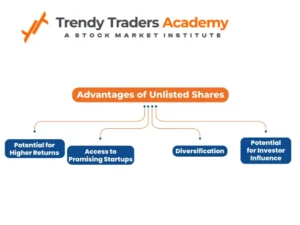
Advantages of NSE Unlisted Shares
This is where investors often explore opportunities using terms like unlisted shares India or look for private market data compared to NSE share price unlisted.
1. Early Entry
- You enter before the crowd – before the IPO hype.
- Many unlisted companies multiply significantly once they list.
2. Higher Return Potential
- Historically, several unlisted shares have delivered exceptional returns pre-IPO. (Examples covered below).
3. Access to High-Growth Companies
- Tech unicorns, consumer brands, fintechs, and emerging B2B companies often stay private for years before listing.
4. Lower Volatility
- Unlisted shares do not react daily to news cycles or market corrections.
5. Diversification
- Adding unlisted shares helps diversify beyond traditional stocks, mutual funds, ETFs, or FDs.
Downsides & Risks
- Low liquidity: Hard to sell unless there’s a ready buyer, or the company lists.
- Valuation uncertainty: Pricing often relies on limited data – could be overvalued or undervalued.
- Limited information visibility: Lack of regular financial disclosures may hide risks.
- Regulatory & compliance risk: Private companies may change structure, get delayed IPOs, or face governance issues.
- Illiquidity lock-in (post-listing restrictions): Even after listing, some shares may have lock-in restrictions. For example – companies or early investors might face a 6-month (or longer) lock-in before freely selling shares post-listing – reducing immediate liquidity for early investors.
- Risk of business failure: Private companies are often less stable; failure may wipe out value entirely.
Examples of Unlisted Shares That Performed Well
Here are real Indian companies whose Unlisted Shares created massive wealth for early investors. These examples often drive searches such as NSE unlisted shares and NSE share price unlisted comparison charts.
These examples demonstrate why investors in unlisted shares India markets are growing every year.
Why Unlisted Shares Are Becoming Popular in India
Search volume for NSE unlisted shares, how to buy unlisted shares, and unlisted shares India has surged because:
- IPO cycles are becoming stronger
- Private companies are staying unlisted longer
- ESOP liquidity programs are expanding
- Retail investors are becoming more informed
- Pre-IPO gains are attracting attention
Investors want to catch high-potential names before the listing buzz begins.
Risks of Investing in Unlisted Shares
While returns can be high, risks must not be ignored:
- Low Liquidity: Selling may take time unless the company approaches IPO.
- Valuation Risk: Private valuations may not always match future NSE share price unlisted expectations.
- Limited Information Transparency: Financial statements are not as detailed as listed firms.
- Regulatory Changes: Unlisted market regulations evolve frequently.
- Timeline Uncertainty: No guarantee when – or if – a company will list.
This is why working with regulated and verified intermediaries like TrendyTraders is so important.
Taxation of Unlisted Shares
- If sold after 2 years – Long-term capital gains (LTCG) at 20% with indexation
- If sold before 2 years – Short-term capital gains (STCG) as per your income slab
Conclusion
Unlisted Shares offer a unique opportunity to invest early in high-potential companies before they hit the stock exchange. They combine the thrill of early-stage investing with the long-term wealth creation potential often associated with start-ups or pre-IPO giants.
From Tata Technologies and CSK to Studds Accessories and HDB Financial, the Indian unlisted market has already created multi-baggers for investors who entered early. Yet, the market is unregulated, pricing is private, and liquidity is lower – making trustworthy intermediaries like TrendyTraders crucial for safe transactions.
FAQ'S
Are Unlisted Shares legal to buy in India?
Yes. Buying and selling unlisted shares is fully legal if done through proper documentation and Demat transfer using verified intermediaries.
How to buy unlisted shares safely?
Always use trusted partners like TrendyTraders, who handle verification, contracts, pricing, and secure Demat transfer.
What is the difference between unlisted shares and NSE unlisted shares price expectation?
Unlisted shares trade privately at negotiated prices, while NSE share price unlisted refers to estimated future valuation once listed.
Are unlisted shares risky?
Yes – due to lower liquidity, uncertain timelines, and limited financial disclosure. But they also offer higher growth potential.
Can unlisted shares be sold before IPO?
Yes. You can exit via private buyers or intermediaries, though liquidity may vary by company.