
Piercing Pattern Candlestick Strategy for Profitable Trades
Candlestick patterns are one of the most powerful tools in technical analysis because they visually represent market psychology. Among bullish reversal patterns, the piercing candle pattern stands out for its simplicity and effectiveness. It often appears at the end of a downtrend, warning traders that selling pressure may be weakening and buyers are stepping in.
At Trendy Traders Academy, traders are taught not to treat candlestick patterns as standalone signals, but as clues within a larger market context. The piercing line candlestick pattern works best when combined with trend analysis, support zones, and volume confirmation.
The piercing pattern candlestick is a bullish reversal candlestick pattern that appears after a downtrend. It signals a potential shift from selling pressure to buyer control when confirmed correctly. Here, you will be learning the meaning of the piercing pattern, the correct way to identify the correct pattern, the psychology of the piercing pattern, the trading strategies which would be used practically and the major mistakes that the traders make.
What Is the Piercing Candle Pattern?
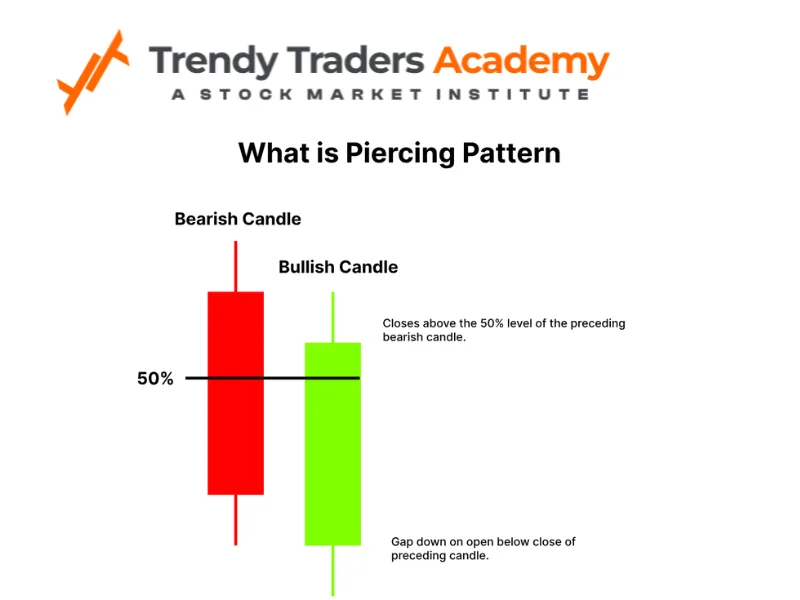
The piercing pattern (also known as the piercing line pattern) is a two-candle bullish reversal pattern that forms after a decline in price.
Structure of the Piercing Pattern Candlestick
First candle:
- Long bearish (red) candle
- Continues the existing downtrend
Second candle:
- Bullish (green) candle
- Opens below the previous candle’s low
- Closes above the midpoint of the first candle
This strong recovery shows that buyers have absorbed selling pressure.
Piercing Pattern Meaning in Trading
The piercing pattern meaning lies in the sudden shift in control from sellers to buyers.
- Sellers dominate during the first candle
- Bears push price lower at the open of the second candle
- Buyers step in aggressively
- Price closes deep into the previous candle’s body
This change in behavior signals a potential bullish reversal, especially near support levels.
Where Does the Piercing Line Pattern Appear?
The piercing line candlestick pattern is most effective when it appears:
- After a clear downtrend
- Near strong support zones
- At demand areas
- After panic selling or news-based drops
Patterns that form randomly in sideways markets are less reliable.
Psychology Behind the Piercing Candle Pattern
Understanding psychology makes this pattern more powerful.
Candle 1 - Seller Confidence
- Bears are in control
- Momentum is downward
- Retail traders panic sell
Candle 2 - Buyer Intervention
- Price opens lower, triggering stop-losses
- Smart money starts accumulating
- Strong buying pushes price above midpoint
- Bears lose confidence
This psychological shift is why the piercing pattern is watched closely by professional traders.
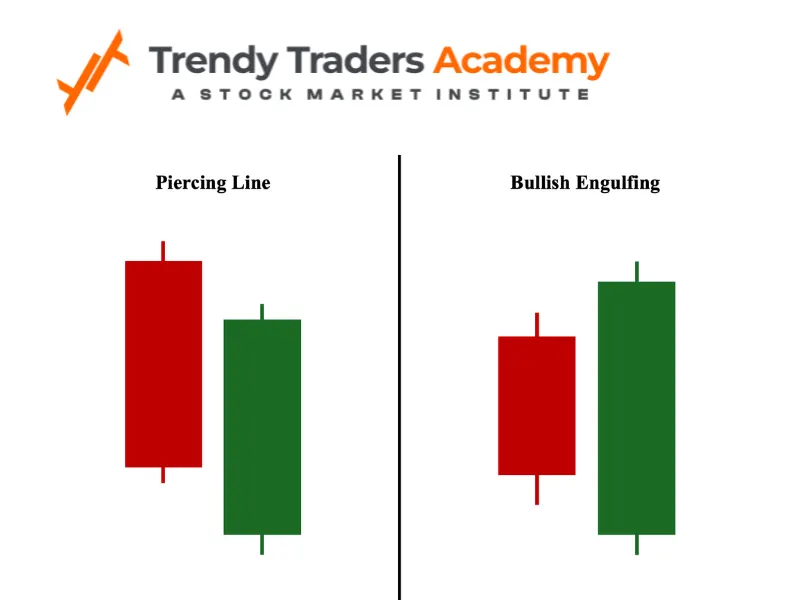
Piercing Line Pattern vs Bullish Engulfing
Many traders confuse these two patterns.
Feature | Piercing Line Pattern | Bullish Engulfing |
Candles | Two | Two |
Close | Above midpoint | Above entire body |
Strength | Moderate | Strong |
Frequency | More common | Less common |
Both are bullish, but engulfing patterns are stronger confirmations.
How to Identify a Valid Piercing Pattern?
To avoid false signals, check these rules:
- Market must be in a downtrend
- First candle should be bearish and strong
- Second candle must open below previous low
- Close must be above 50% of first candle
- Higher volume improves reliability
Skipping these rules reduces accuracy.
Piercing Pattern Candlestick in Market Structure
Candlestick patterns work best when aligned with market structure.
If the piercing pattern forms:
- Near a higher timeframe support
- After selling exhaustion
- Alongside slowing momentum
It becomes a high-probability reversal signal rather than just a candle formation.
Step-by-Step Trading Setup
The Piercing pattern is a bullish reversal pattern that appears after a downtrend. It shows that sellers are losing strength and buyers are starting to take control.
Identify a clear downtrend
Price should be making lower highs and lower lows.
Mark a support or demand zone
Look for previous lows or strong support where price can reverse.
Spot the Piercing Candle pattern
- First candle: strong bearish candle
- Second candle: bullish candle that opens near the low and closes above the midpoint of the previous candle
Wait for confirmation
Enter only if the next candle is bullish. This avoids false signals.
Entry point
Buy above the high of the bullish piercing candle.
Stop-loss
Place stop-loss below the recent swing low.
Why this works?
- Trades only at support
- Confirms buyer strength before entry
- Reduces premature and emotional trades
In short: Piercing Candle = downtrend + support + confirmation = safer bullish reversal setup.
Stop-Loss and Target Placement
Stop-Loss
- Below the low of the piercing pattern
- Or below the nearest support level
Targets
- Previous resistance zone
- 1:2 or higher risk-reward
- Trailing stop in trending markets
Risk management is more important than pattern accuracy.
Piercing Line Candlestick Pattern with Indicators
The piercing pattern becomes stronger when combined with:
- RSI below 30 (oversold)
- Positive divergence
- Increasing volume
- VWAP support (for intraday traders)
- Moving average convergence
Indicators should confirm, not replace price action.
Piercing Pattern in Intraday Trading
Intraday traders can use this pattern on:
- 5-minute charts
- 15-minute charts
- Bank Nifty and Nifty futures
- High-volume stocks
The key is context-avoid trading it during low-volume periods.
Piercing Pattern in Indian Stock Markets
In Indian markets listed on National Stock Exchange of India (NSE) and Bombay Stock Exchange (BSE), piercing patterns often appear:
- After gap-down openings
- Near circuit-limit zones
- During expiry sessions
- After earnings-based selloffs
Institutional participation adds reliability to the pattern.
Common Mistakes Traders Make
- Trading without a downtrend
- Ignoring confirmation candles
- Using tight stop-losses
- Overtrading the pattern
- Ignoring market structure
Avoiding these mistakes improves consistency.
Reliability of the Piercing Line Pattern
Historical studies in technical analysis show:
- Success rate improves above 60% when used with support
- Works best in trending markets
- Less effective in sideways markets
- Higher volume increases probability
No pattern works 100% of the time-context matters.
Piercing Pattern vs Dark Cloud Cover
These two are opposites.
Piercing Pattern | Dark Cloud Cover |
Bullish | Bearish |
Appears after downtrend | Appears after uptrend |
Buyers regain control | Sellers regain control |
Understanding both helps traders read reversals faster.
Who Should Use the Piercing Pattern?
- Swing traders
- Positional traders
- Intraday traders
- Beginners learning price action
Traders are taught to combine candlestick patterns with structure and risk management for consistent results.
Real Trading Example
A stock declines 12% over five sessions and approaches a long-term support zone. A strong bearish candle forms, followed by a bullish candle that closes above the midpoint of the prior candle with increased volume.
This confirms:
- Selling exhaustion
- Buyer entry
- Potential short-term reversal
Such setups offer favorable risk-reward opportunities.
Conclusion
The piercing candle pattern is an effective but easy pattern of bullish reversal when applied well. It points out a change in market psychology -the fear selling to confidence buying. Learning these patterns assists traders to think rationally, trade patiently and risk management; important things that are always taught at Trendy Traders Academy.
But it is its strength in its context rather than isolation. The piercing line candlestick pattern used together with the trend analysis, support zones, and appropriate risk management is a useful tool for traders over both timeframes. Wait and get confirmation and alignment of structure as opposed to following each candle.
Also Download : Trendy Traders Academy’s Candlestick Patterns PDF.
Check more Candlestick Patterns
Bullish, bearish, neutral, continuation, and reversal patterns help traders identify market direction, momentum, and possible trend changes. | |
Signals a possible bullish reversal after a downtrend as buyers reject lower prices. | |
Inverted Hammer Candlestick Pattern | Signals a possible bullish reversal after a downtrend as buyers reject lower prices. |
Indicates potential bullish reversal where buying pressure appears after a decline. | |
Patterns that indicate buying strength and possible upward trend reversal or continuation. | |
Patterns that signal selling pressure and a potential downward trend reversal. | |
Confirms a strong bullish trend with three consecutive long bullish candles. | |
Warns of a possible bearish reversal after an uptrend due to selling pressure. | |
Shooting Star Candlestick Pattern | Indicates bearish reversal when price rejects higher levels after an uptrend. |
Signals a bullish reversal using a three-candle structure after a downtrend. | |
Indicates a bearish reversal at the top using a three-candle formation. | |
A bearish reversal pattern where sellers enter strongly after a bullish move. | |
Three Black Crows Pattern | Confirms strong bearish momentum with three long consecutive bearish candles. |
Doji Candlestick Pattern | Shows market indecision where buyers and sellers are equally balanced. |
Marubozu Candlestick Pattern | Represents strong momentum with no price rejection, indicating trend continuation. |
Reflects uncertainty and loss of momentum in the current trend. | |
A smoothed candlestick method that reduces market noise and helps traders clearly identify trends. |
FAQ'S
What is the piercing candle pattern?
A bullish reversal candlestick pattern formed by two candles after a downtrend.
Is the piercing line pattern reliable?
Yes, especially when combined with support levels and confirmation.
Can beginners trade the piercing pattern?
Yes, it is simple and beginner-friendly when rules are followed.
What confirms a piercing pattern?
High volume, support zones, and a confirmation candle improve accuracy.
Does the piercing pattern work in intraday trading?
Yes, it works well on lower timeframes with proper context.