Best Price Action Trading Strategies That Work in 2026: Real Techniques Used by Profitable Traders
Quick Answer: What Is Price Action Trading?
Price action trading is a trading method where traders make decisions based on pure price movement instead of relying heavily on indicators. It involves analyzing candlestick patterns, market structure, support and resistance zones, breakout setups, and trend behavior to identify high-probability trading opportunities.
Introduction
Trading indicators can confuse traders.
One indicator says buy. Another says sell. Meanwhile, the market moves without waiting for confirmation.
That’s exactly why experienced traders eventually shift toward price action trading strategies.
In 2026, markets are faster, more volatile, and heavily influenced by algorithms, smart money activity, global news, and liquidity movements. Traders relying only on lagging indicators are often entering late and exiting emotionally.
But traders who understand price movement analysis, market structure, support and resistance, and candlestick behavior are gaining a significant edge.
This guide will outline the most successful price action trading strategies employed by today’s top traders, including practical examples, risk management tips and the psychology behind the markets.
Whether you’re a beginner or an intermediate trader, this article will help you understand how to read charts like experienced traders do.
What Is Price Action Trading?
Price action trading is the art of analyzing raw market movement without depending excessively on indicators.
Instead of cluttering charts with multiple tools, traders focus on:
- Candlestick formations
- Market structure
- Support and resistance
- Momentum shifts
- Volume behavior
- Liquidity zones
- Breakout failures
- Trend continuation patterns
This approach is also called:
- Naked chart trading
- Pure price action trading
- Technical price action analysis
Professional traders often prefer price action because it reflects the direct psychology of buyers and sellers.
Why Price Action Trading Works Better in 2026
Modern markets have changed dramatically.
Today’s trading environment includes:
Market Factor | Impact on Traders |
Algorithmic Trading | Faster fakeouts |
High Volatility | Sudden reversals |
Retail Participation | Emotional movements |
AI-driven Trading Systems | Increased liquidity hunts |
Global Events | Instant market reactions |
Indicators lag.
Price reacts first.
That’s why experienced traders prioritize:
- Market structure trading
- Smart money trading
- Price movement analysis
- Candlestick confirmation
Core Principles of Price Action Trading
Before learning strategies, understand these foundational concepts.
1. Market Structure Matters Most
Markets move in:
Higher highs and higher lows (uptrend)
Lower highs and lower lows (downtrend)
Consolidation ranges
Professional traders first identify structure before entering trades.
2. Price Leaves Clues
Large candles, rejection wicks, fake breakouts, and aggressive momentum candles reveal institutional activity.
3. Context Is More Important Than Patterns
A bullish engulfing candle at resistance is weaker than the same pattern at strong support.
Context always wins.
4. Risk Management Is Non-Negotiable
Even the best price action strategy fails sometimes.
Professional traders survive because they manage losses properly.
Best Price Action Trading Strategies That Work in 2026
1. Support and Resistance Trading
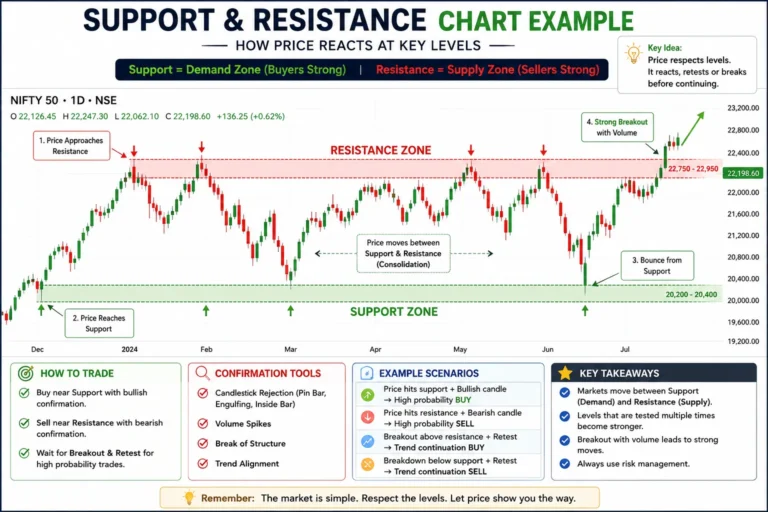
One of the oldest yet most powerful price action strategies.
How It Works
Price repeatedly reacts from important levels.
These zones become:
Support
Resistance
Breakout areas
Entry Process
Identify key zones
Wait for price reaction
Look for candlestick confirmation
Enter with proper stop loss
Best Confirmation Candles
Pin bar
Engulfing candle
Inside bar breakout
Rejection wick candles
Example
Imagine Nifty approaching a major resistance level after strong bullish momentum.
Suddenly:
Price forms long upper wicks
Momentum slows
Bearish engulfing candle appears
This often signals institutional selling pressure.
2. Breakout Trading Strategy
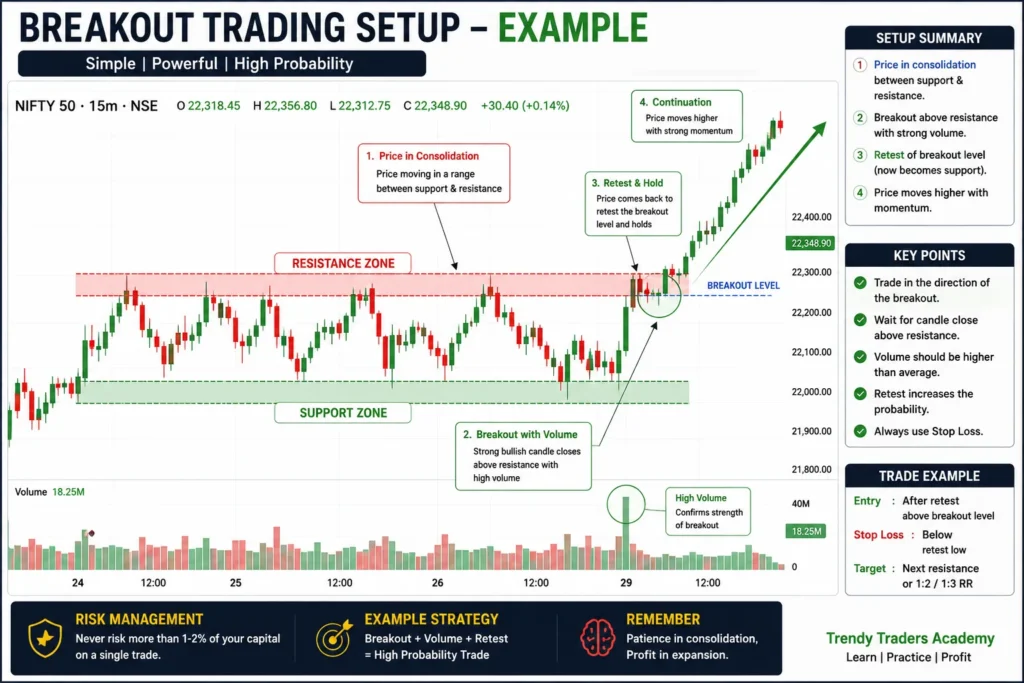
Breakout trading remains one of the highest-reward setups when executed properly.
What Is a Breakout?
A breakout occurs when price escapes consolidation or a major resistance/support zone with strong momentum.
Best Breakout Conditions
Strong Breakout | Weak Breakout |
High volume | Low volume |
Momentum candles | Small candles |
Multiple retests | Random spike |
Market trend alignment | Against trend |
Expert Insight
Most beginners enter early.
Professionals wait for:
Candle close confirmation
Retest
Momentum continuation
This reduces fake breakouts significantly.
3. Trend Trading Strategy
“The trend is your friend” still works in 2026.
How Trend Traders Operate
They:
Identify dominant direction
Enter during pullbacks
Avoid countertrend trading
Simple Trend Trading Framework
Uptrend | Downtrend |
Higher highs | Lower highs |
Higher lows | Lower lows |
Buy dips | Sell rallies |
Powerful Trend Entry Techniques
EMA pullback + price action
Trendline rejection
Breakout continuation
Flag pattern breakout
4. Candlestick Price Action Strategy
Candlesticks reveal emotional behavior.
Fear, greed, panic, accumulation — everything appears on charts.
Most Effective Candlestick Patterns
Bullish Engulfing
Signals aggressive buyer entry.
Bearish Engulfing
Shows strong seller dominance.
Pin Bar
Represents rejection from important levels.
Doji
Indecision in the market.
Inside Bar
Volatility contraction before expansion.
Candlestick Psychology Most Traders Ignore
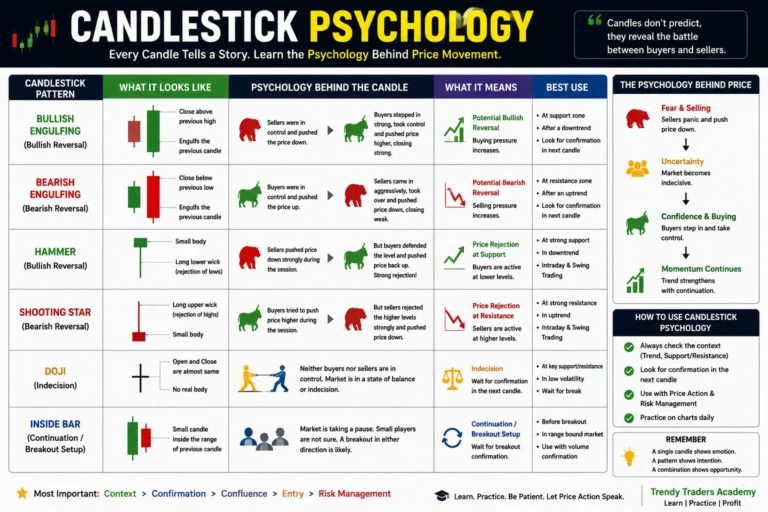
Many traders memorize patterns but fail to understand psychology.
Example:
A bullish candle after 10 green candles is weaker than a bullish candle after panic selling.
Context changes probability.
That’s what separates professionals from beginners.
Market Structure Trading
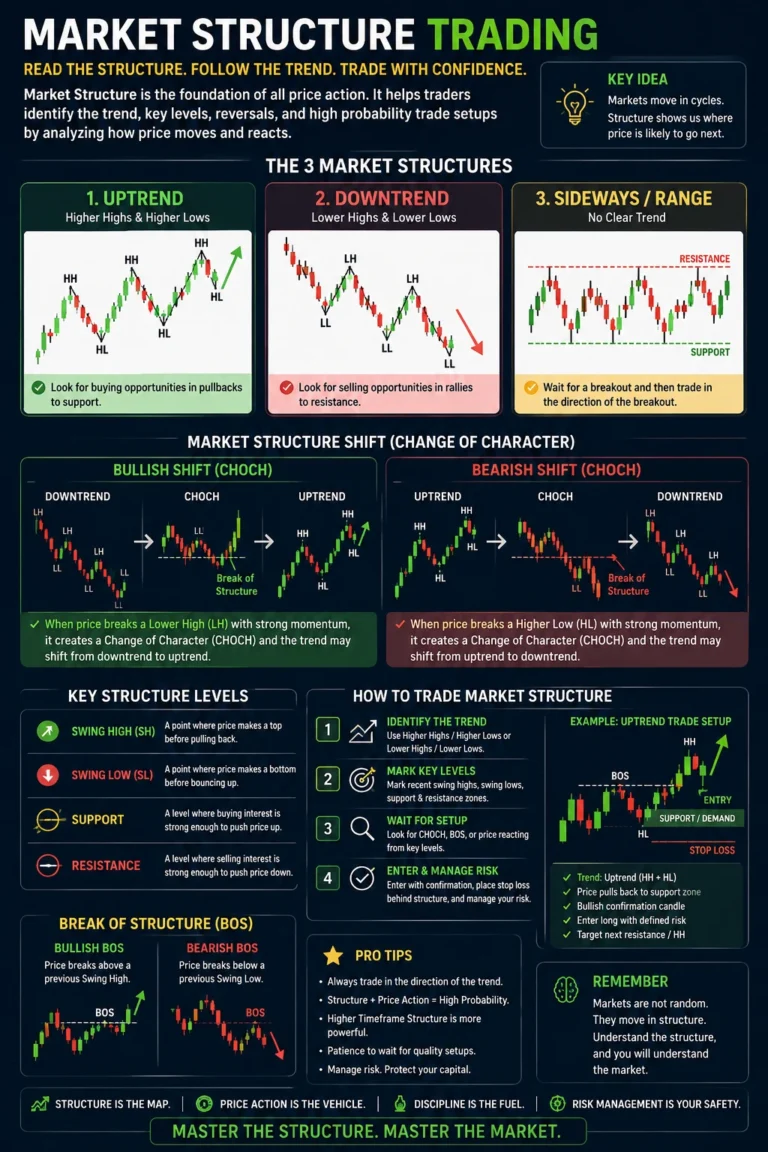
This is where many profitable traders focus heavily in 2026.
What Is Market Structure?
Market structure refers to:
Swing highs
Swing lows
Trend shifts
Break of structure
Change of character
Smart money traders analyze:
Liquidity grabs
Institutional zones
Order flow behavior
Simple Market Structure Setup
Bullish Setup
Market creates higher highs
Pullback occurs
Support holds
Bullish candle confirms entry
Bearish Setup
Lower highs form
Weak bounce occurs
Resistance rejects price
Bearish confirmation appears
6. Supply and Demand Trading
Supply and demand zones are areas where institutional orders previously entered.
These zones often create explosive reactions.
Supply Zone
Strong selling previously occurred.
Demand Zone
Strong buying previously occurred.
Why It Works
Institutions rarely enter full positions at once.
They often leave unfilled orders behind.
When price revisits those zones, reactions happen again
Intraday Price Action Trading Strategies
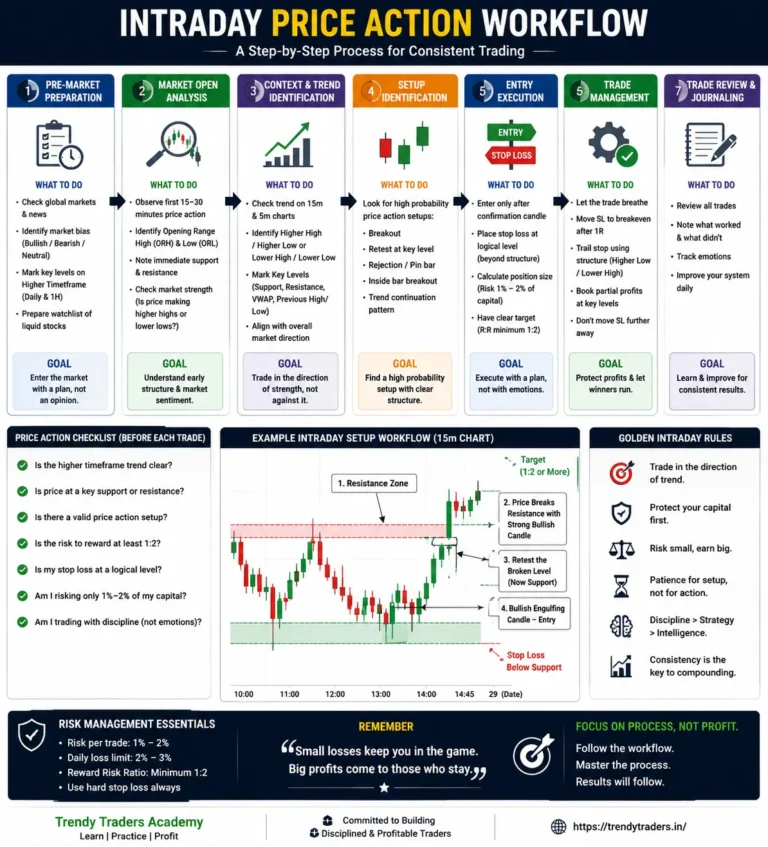
Intraday traders need speed and discipline.
Best Intraday Setups
Opening Range Breakout
Trade the breakout of the first 15–30 minute range.
VWAP + Price Action
Use VWAP as directional bias.
Trend Pullback Strategy
Trade retracements during trending sessions.
Fake Breakout Reversal
Excellent during volatile sessions.
Intraday Trading Rules Professionals Follow
- Never overtrade
- Avoid revenge trading
- Use fixed risk
- Respect stop losses
- Trade liquid stocks only
Swing Trading Price Action Strategies
Swing traders focus on multi-day moves.
Best Swing Trading Patterns
Pattern | Purpose |
Trend continuation | |
Bull Flag | Momentum continuation |
Reversal | |
Breakout setup |
Swing traders often combine:
Daily timeframe
Weekly trend
Sector strength
Relative momentum
Naked Chart Trading: Why Professionals Prefer Clean Charts
Many successful traders use almost no indicators.
Why?
Because:
- Indicators lag
- Too many signals create confusion
- Simplicity improves execution
A clean chart helps traders focus on:
- Price
- Structure
- Momentum
- Liquidity
This is called naked chart trading.
Smart Money Trading and Price Action
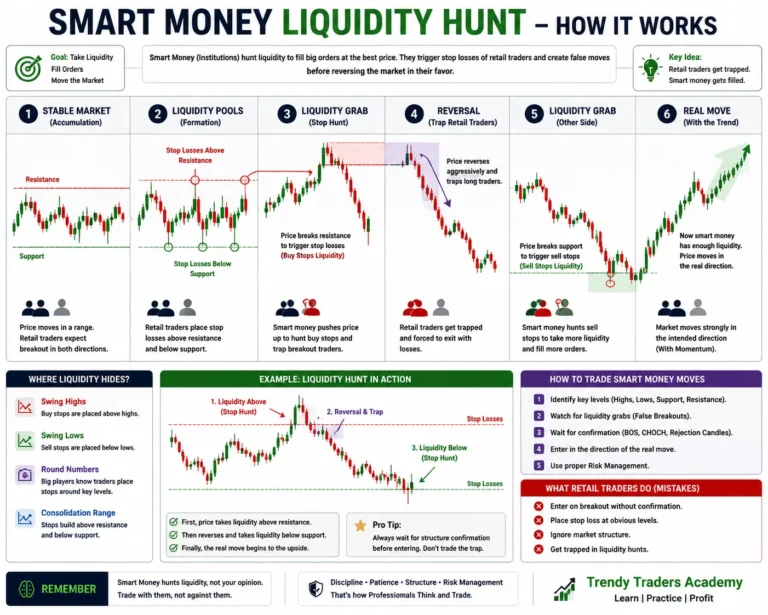
In 2026, traders increasingly study smart money concepts.
What Smart Money Looks For
Liquidity pools
Stop hunts
Imbalances
Order blocks
Break of structure
Retail traders often enter emotionally.
Institutions exploit emotional traders.
Understanding price action helps traders avoid becoming liquidity.
Risk Management: The Difference Between Gamblers and Professionals
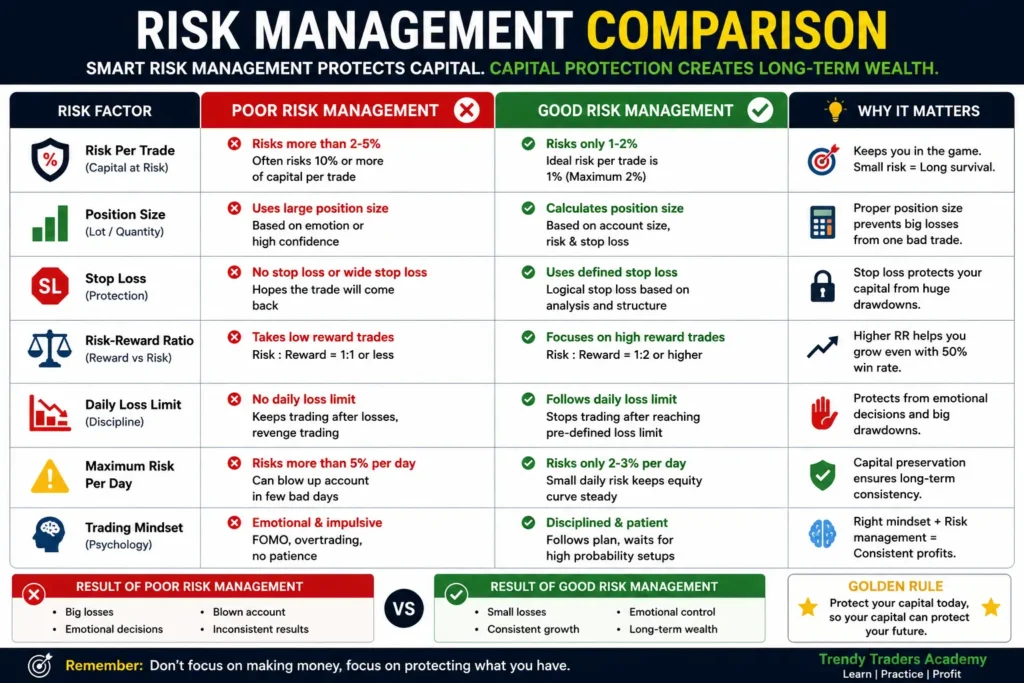
Most traders focus only on entries.
Professionals focus on:
Risk-to-reward ratio
Position sizing
Capital preservation
Consistency
Golden Risk Rules
Rule | Recommendation |
Risk per trade | 1–2% |
Minimum RR ratio | 1:2 |
Daily loss limit | Fixed |
Avoid emotional doubling | Essential |
Trading Psychology Secrets Most Traders Learn Too Late
Trading is more psychological than technical.
Emotional Mistakes Traders Make
Fear of missing out
Revenge trading
Overconfidence
Impulsive entries
Exiting winners too early
Real Professional Mindset
Winning traders:
Think in probabilities
Accept losses
Stay disciplined
Avoid emotional attachment
A Real-World Trading Example
Suppose Bank Nifty opens bullish after positive global cues.
Price breaks resistance aggressively.
Most beginners buy immediately.
Professionals wait.
After breakout:
- Price retests resistance
- Buyers defend level
- Bullish engulfing candle forms
That’s where experienced traders enter.
The difference is patience.
Common Beginner Mistakes in Price Action Trading
1. Overtrading
More trades do not equal more profits.
2. Ignoring Higher Timeframes
Lower timeframe noise destroys clarity.
3. Using Too Many Indicators
This creates analysis paralysis.
4. Emotional Stop Loss Changes
A major account killer.
5. Trading Without Context
Patterns alone are not enough.
Best Timeframes for Price Action Trading
Trading Style | Best Timeframe |
1–5 min | |
5–15 min | |
1H–Daily | |
Positional Trading | Daily–Weekly |
How to Learn Price Action Trading Properly
Most traders fail because they:
- Learn random YouTube setups
- Lack structure
- Skip psychology
- Ignore risk management
A proper learning system matters.
That’s why many traders now prefer structured mentorship programs instead of fragmented free content.
Why Many Traders Prefer Trendy Traders Academy
Trendy Traders Academy has become one of the recognized names in stock market education in India, especially among traders looking to learn practical price action trading and real-world market execution.
According to their training material, the institute has trained over 30,000+ students since 2018 through online and offline programs focused on:
- Technical analysis
- Price action trading
- Risk management
- Market structure
- Live trading mentorship
Their programs include:
- Technical Analysis Course
- Live market sessions
- Trading workshops
- Structured mentorship programs
Many learners specifically follow mentor Abhishek Jha for his practical teaching approach and real-market execution insights. The academy highlights his 15+ years of trading experience and NISM SEBI Investor certification.
For beginners struggling with:
- chart reading,
- trading psychology,
- support and resistance,
- or intraday execution,
structured learning often shortens the learning curve significantly.
Comparison: Indicator Trading vs Price Action Trading
Factor | Indicator Trading | Price Action Trading |
Signal Speed | Delayed | Faster |
Complexity | High | Moderate |
Flexibility | Limited | High |
Market Understanding | Surface-level | Deep |
Adaptability | Lower | Higher |
Expert Tips for Mastering Price Action Trading
1. Focus on One Setup
Master one strategy first.
2. Journal Every Trade
Track:
Entry
Exit
Emotion
Mistakes
3. Learn Patience
Waiting is a skill.
4. Respect Risk
No strategy guarantees certainty.
5. Replay Charts Daily
This improves pattern recognition dramatically.
Conclusion
The market rewards traders who understand behavior — not just indicators.
That’s why price action trading strategies remain powerful even in 2026.
Whether you trade intraday, swing trade, or invest long term, learning:
- market structure,
- support and resistance,
- candlestick psychology,
- and smart money behavior
can dramatically improve decision-making.
The goal isn’t predicting every move.
The goal is understanding probability, managing risk, and executing with discipline.
And if you’re serious about building strong trading foundations, structured mentorship and real-market guidance can accelerate the journey significantly.
Many traders today are turning toward expert-led education platforms like Trendy Traders Academy to learn practical trading skills, live execution techniques, and professional-level market understanding from mentors like Abhishek Jha.
People Also Ask (PAA) Questions
Is price action trading profitable?
Yes, price action trading can be profitable when combined with discipline, proper risk management, and strong market understanding.
Which is the best price action strategy?
Support and resistance trading combined with market structure analysis is considered one of the most reliable price action strategies.
Can beginners learn price action trading?
Yes. Beginners often understand charts better through price action because it simplifies market analysis.
Does price action work in forex and stocks?
Yes. Price action trading works across:
- Stocks
- Forex
- Crypto
- Commodities
- Indices
FAQS
What is pure price action trading?
Pure price action trading means analyzing raw price movement without depending heavily on indicators.
Which timeframe is best for price action trading?
Daily and 1-hour charts are considered highly reliable for beginners.
Is price action better than indicators?
Price action reacts faster because indicators are derived from historical price.
How long does it take to learn price action?
Most traders need several months of consistent chart practice.
What is the best candlestick pattern?
No single pattern is best. Context matters more than patterns alone.
Is price action good for intraday trading?
Yes. Many professional intraday traders use price action setups for quick decision-making.
Why do most traders fail?
Main reasons include:
- Lack of discipline
- Poor risk management
- Emotional trading
- Overtrading
Can I trade without indicators?
Yes. Many professionals trade using naked charts.
What is smart money trading?
It involves tracking institutional behavior using liquidity and market structure concepts.
Is price action enough for consistent trading?
Price action combined with psychology and risk management can build consistency over time.