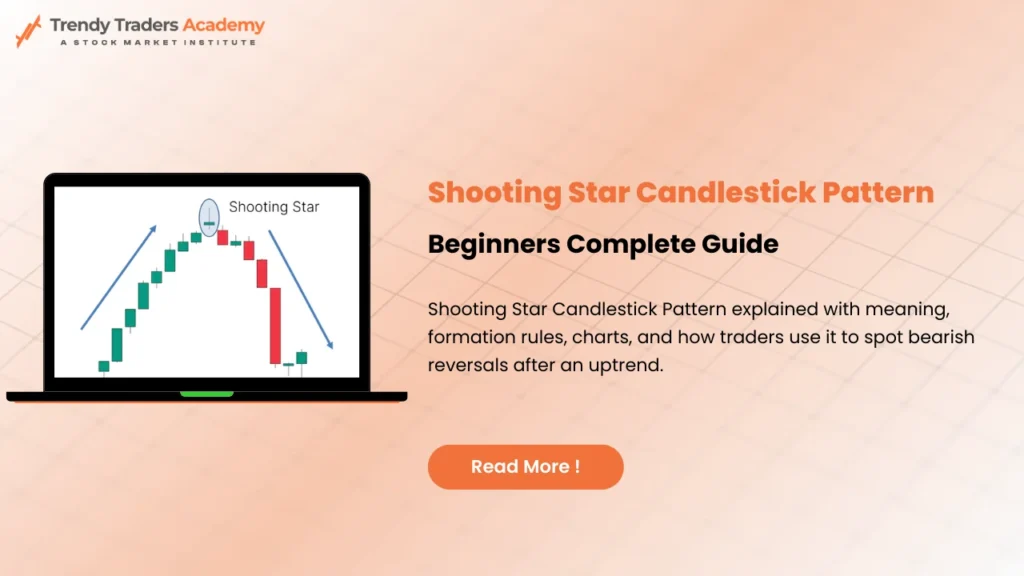
Shooting Star Candlestick Pattern Beginners Complete Guide
When traders hear the term shooting star, most imagine something beautiful streaking across the night sky. In trading, however, a shooting star often means the opposite. It is a quiet warning that the market may be losing strength after a strong rise.
The shooting star candlestick chart is among the price-action indicators that appears straightforward but has a significant meaning. It does not do this with accuracy but it explains a clear picture of what occurred in a trading session. Buyers tried to push prices higher, failed, and sellers stepped in with force.
For Indian traders, this pattern appears frequently on stocks, indices, and even intraday charts. Understanding candlestick patterns can help you avoid buying near market tops, protect profits, or even plan short trades with controlled risk. In this guide, we’ll break the concept down in plain language, explore real-life Indian market behaviour, and explain how traders actually use the shooting star candle pattern in practice.
What is Shooting Star Candlestick Pattern?
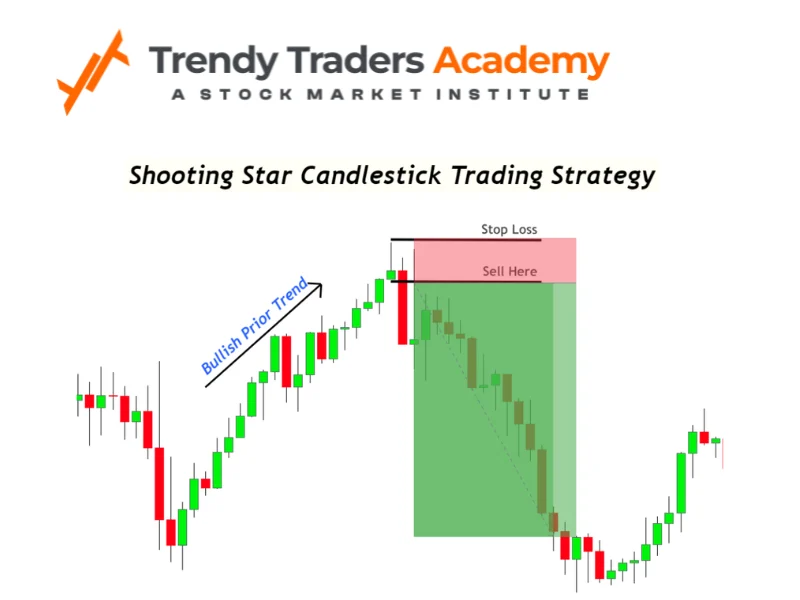
Shooting star is a reversal pattern but a bearish single-candle pattern. It normally appears at the end of an uptrend and is an indication that the bullish movement is weakening.
The candle may seem innocent on the face of it. You can see its structure, though, and then the message is clear.
How a Shooting Star Candle Pattern Looks?
A classic shooting star candle has:
- A small real body near the lower end of the range
- A long upper shadow (usually at least twice the body)
- Very little or no lower shadow
This shape shows that prices moved sharply higher during the session but couldn’t stay there.
The Story Behind the Candle (Why It Matters)
Candlestick patterns are powerful because they reflect market psychology.
Here’s what typically happens during a shooting star session:
- The market opens and buyers stay confident
- Price pushes higher, often breaking recent highs
- At higher levels, sellers begin selling aggressively
- Buying pressure dries up
- Price falls back near the opening level
By the close, the candle tells one simple story: Buyers lost control. Sellers pushed back. That shift in control is why traders pay attention to this pattern.
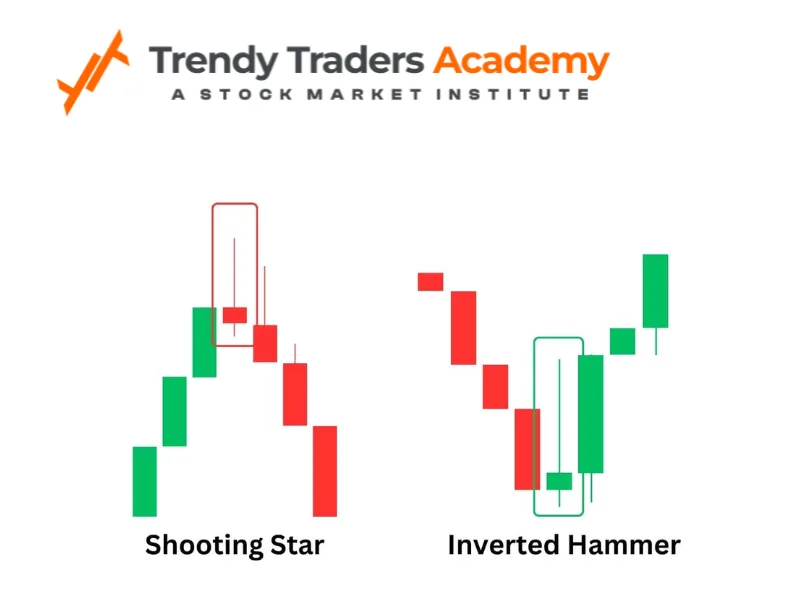
Shooting Star vs Similar-Looking Candles
Many beginners confuse the shooting star candle pattern with other patterns. Context is what separates them.
Aspect | Shooting Star | Inverted Hammer |
Trend before pattern | Uptrend | Downtrend |
Market signal | Bearish | Bullish |
Meaning | Exhaustion at top | Potential bottom |
The shape may look similar, but the trend before the candle completely changes its meaning.
Where the Shooting Star Pattern Works Best?
The shooting star candle pattern is most effective when it appears in the right location.
High-probability zones include:
- Near previous resistance levels
- Around all-time highs
- After a fast, extended rally
- Near psychological levels (₹100, ₹500, ₹1000)
When it appears randomly in sideways markets, its reliability drops sharply.
Indian Market Example: Index Context
Imagine NIFTY has been rising steadily for ten sessions and approaches a previous resistance zone. On the daily chart, it forms a shooting star chart pattern with a long upper wick and closes near the day’s low.
What usually follows?
- Profit booking by short-term traders
- Sideways consolidation or mild correction
- Increased volatility in the next few sessions
This doesn’t always mean a crash, but it does warn traders to be cautious.
Indian Stock Example: Large-Cap Behaviour
Consider a large-cap stock rallying strongly after results. Volume spikes as price moves to a fresh high. By the end of the day, a shooting star candle forms.
This often indicates:
- Institutional selling at higher levels
- Retail buying exhaustion
- Short-term trend pause
Experienced traders either book partial profits or wait for confirmation before taking fresh positions.
Confirmation: The Rule You Should Never Ignore
A shooting star chart pattern alone is not enough.
Confirmation usually comes when:
- The next candle closes below the shooting star’s low
- Bearish volume increases
- Price fails to reclaim the upper wick
Without confirmation, the candle is only a warning, not a trade signal.
How Traders Actually Trade the Shooting Star Candlestick Pattern?
Entry Logic
Most traders:
- Wait for confirmation on the next candle
- Enter short below the low of the shooting star
- Avoid anticipating the move
- Patience is key.
Stop Loss Placement
A logical stop loss is:
- Just above the high of the shooting star
This keeps the risk small and well-defined.
Targets and Exits
Common target zones include:
- Previous support levels
- 20 EMA or 50 EMA
- Recent swing lows
Risk-reward is more important than being right every time.
Using the Shooting Star in Intraday Trading
On intraday charts:
- It works best on 15-minute and 30-minute timeframes
- Strongest near VWAP or day’s high
- More reliable when the broader trend is weak
Intraday traders often combine it with volume spikes and momentum slowdown.
Shooting Star chart pattern for Swing Traders
Swing traders look for:
- Shooting stars on daily or weekly charts
- Patterns forming near resistance zones
- Confirmation over the next 1-3 sessions
Weekly shooting stars near major resistance levels often signal medium-term pauses.
Common Mistakes Traders Make
Many traders misuse the shooting star chart pattern. Common errors include:
- Trading it in sideways markets
- Ignoring the prior trend
- Entering without confirmation
- Placing stop losses inside the wick
- Treating it as a guarantee
Candlestick patterns work on probability, not certainty.
How Reliable Is the Shooting Star Pattern?
No candlestick pattern works all the time.
The shooting star candle pattern tends to perform better:
- On higher timeframes
- After extended rallies
- When combined with resistance and volume
Professional traders treat it as a risk-management signal, not a prediction tool.
Shooting Star and Algorithmic Trading
In rule-based systems, the shooting star can be defined objectively using:
- Wick-to-body ratio
- Trend filters
- Volume conditions
Traders should backtest such conditions instead of relying on visual judgement. This helps remove emotional bias and improves consistency.
Is the Shooting Star Always Bearish?
Not always.
- In strong bull markets: It may lead to consolidation rather than reversal
- In weak or overextended markets: It often signals short-term trend change
- Context decides outcome, not the candle alone.
Who Should Use the Shooting Star Pattern?
The shooting star candle pattern is useful for:
- Price-action traders
- Swing traders
- Intraday traders
- Systematic traders
It suits traders who prefer clear risk levels and simple setups.
Why Beginners Should Learn This Pattern?
The shooting star chart pattern teaches:
- Patience
- Trend awareness
- Risk control
- Market psychology
Even if you don’t trade it actively, recognising it can help you avoid poor entries near market tops.
Conclusion
The shooting star candlestick pattern of the market is a small yet very strong indicator. It doesn’t shout, it whispers. It informs you that the market made an attempt to climb up and lost. The first symptom of exhaustion is usually that failure.
When applied appropriately, the shooting star will assist a trader to deal with risk, cushion profit, and to prevent the making of emotional decisions. When it is applied mindlessly it is an additional false form on a chart. The difference lies in context, confirmation, and discipline.
Whether you trade manually or through systematic strategies, understanding what the shooting star represents will sharpen your market reading skills. In trading, seeing what didn’t work is often more valuable than seeing what did.
Also Download : Trendy Traders Academy’s Candlestick Patterns PDF.
Check more Candlestick Patterns
Bullish, bearish, neutral, continuation, and reversal patterns help traders identify market direction, momentum, and possible trend changes. | |
Signals a possible bullish reversal after a downtrend as buyers reject lower prices. | |
Inverted Hammer Candlestick Pattern | Signals a possible bullish reversal after a downtrend as buyers reject lower prices. |
Indicates potential bullish reversal where buying pressure appears after a decline. | |
Patterns that indicate buying strength and possible upward trend reversal or continuation. | |
Patterns that signal selling pressure and a potential downward trend reversal. | |
A bullish reversal pattern where buyers regain control after a strong bearish move. | |
Confirms a strong bullish trend with three consecutive long bullish candles. | |
Warns of a possible bearish reversal after an uptrend due to selling pressure. | |
Signals a bullish reversal using a three-candle structure after a downtrend. | |
Indicates a bearish reversal at the top using a three-candle formation. | |
A bearish reversal pattern where sellers enter strongly after a bullish move. | |
Three Black Crows Pattern | Confirms strong bearish momentum with three long consecutive bearish candles. |
Doji Candlestick Pattern | Shows market indecision where buyers and sellers are equally balanced. |
Marubozu Candlestick Pattern | Represents strong momentum with no price rejection, indicating trend continuation. |
Reflects uncertainty and loss of momentum in the current trend. | |
A smoothed candlestick method that reduces market noise and helps traders clearly identify trends. |
FAQ'S
What is a shooting star candlestick pattern?
A bearish reversal pattern that appears after an uptrend.
Is a shooting star always bearish?
It is bearish by nature but needs confirmation.
Can shooting star work in intraday trading?
Yes, especially near resistance or VWAP.
What confirms a shooting star candle?
A bearish candle closing below its low.
Where should stop loss be placed?
Above the high of the shooting star.